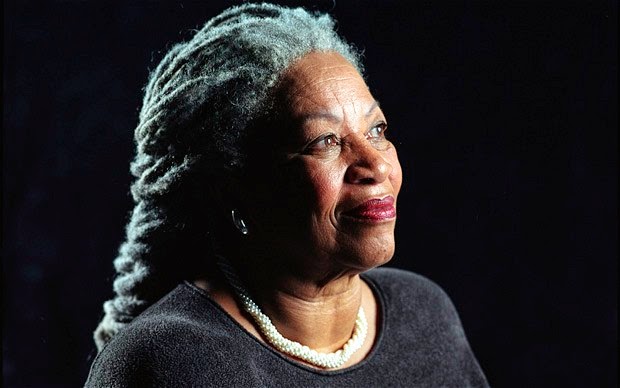
Toni Morrison, born Chloe Ardelia Wofford in Lorain, Ohio on Feb. 18, 1931, transformed the landscape of American literature with her unyielding discussions on the most uncomfortable topics.
The first Black woman to win the Nobel Peace Prize in Literature in 1993, Morrison proved a radical force for her time. Her legacy remains to this day as a Black female novelist who refused to integrate white characters into her stories. Upon being questioned in 1998 about when she would ever “substantially” include white people in her work, she immediately called out the interviewer’s double-standards.
“You can’t understand how powerfully racist that question is, can you?” Morrison said. “As you could never ask a white author: when are you going to write about Black people?”
Morrison never shied away from admitting that she wrote primarily about and for Black women, whose voices and stories have been historically subjugated to a lower class of artistry and literary excellence. With the labels “Black” and “female” immediately attached to her work, Morrison embraced her identity as “a rich place to write from,” that is, something that “expands [her imagination].”
And by no means was her prose gentle, rather unhesitatingly graphic and violent, expounding on the darkest parts of humanity’s history through fictional retellings.

Morrison’s debut and first encounters with censorship
Set in her hometown of Lorain, Morrison’s first novel, titled “The Bluest Eye” (1970), follows the journey of an African-American girl named Pecola who, upon experiencing verbal torment for her “ugly” dark skin and mannerisms, longed to have blue eyes. The novel’s explicit depictions of child sexual assault, rape, incest and violence reflect larger thematic discussions on racism, identity, beauty standards and longing for acceptance.
Today, “The Bluest Eye” is completely banned in some school districts and has been removed from curriculums across the country. Morrison’s own home state of Ohio has seen attempts to no longer classify the book as a recommended reading and to ban its presence in classrooms.
“I see an underlying socialist-communist agenda … that is anti what this nation is about,” Mark Smith, then-president of Ohio Christian University, remarked in 2013.
No amount of attempted censorship, however, hampered the decent critical success that “The Bluest Eye” enjoyed, from a positive review in The New York Times to incorporation into Black studies programs at colleges and universities nationwide. As staggering, painful and radically provocative as the novel was for its time, the public readership recognized its unparalleled contribution to the growing body of American literature.
A life-long advocate against censorship
Morrison’s experience with success and censorship in her literary debut would not be her last.
“Sula” published in 1973, “Song of Solomon” in 1977, “Beloved” in 1987, “Paradise” in 1997, all esteemed works of Morrison’s with intense expositions on racism, sexism, violence and other parts of the Black experience, have fallen victim to attempted censorship across the country – both during her time and after.
Amid the simultaneous renown and refusal, Morrison spent her entire life advocating against censorship, supporting libraries and open access to literature – not just as a storyteller, but as a professor and woman of color who fostered the publication of other Black authors, such as Angela Davis and Muhammad Ali.

“Access to knowledge is the superb, the supreme act of truly great civilizations,” said Morrison. “Of all the institutions that purport to do this, free libraries stand virtually alone in accomplishing this mission. No committee decides who may enter, no crisis of body or spirit must accompany the entrant. No tuition is charged, no oath sworn, no visa demanded. Of the monuments humans build for themselves, very few say ‘touch me, use me, my hush is not indifference, my space is not a barrier.’ If I inspire awe, it is because I am in awe of you and the possibilities that dwell in you.”
With an anthology thematically contrary to the literary and social status quo, Morrison witnessed the censorship of her stories until she passed on Aug. 5, 2019, aged 88.
Having won the Pulitzer Prize for Fiction in 1988, “Beloved” is by far Morrison’s most critically acclaimed work. Inspired by the true story of Margaret Garner, an enslaved woman who killed her daughter in 1882 to spare her a life in slavery, “Beloved” continues to spark literary discourse for its unique exploration of family, trauma and Black collective memory by means of fiction and even the supernatural.
However, challenges to “Beloved” have persisted in such a way that it has become a regular fixture on the American Library Association (ALA)’s yearly list of the top 10 most challenged books. In the 2021-2022 academic year, more than 10 U.S. schools banned the book for reasons such as infanticide, bestiality, sex and violence.
“What [Morrison] tried to do [in ‘Beloved’] is convey the trauma of the legacy of slavery to her readers. That is a violent legacy,” Emily Knox, author of “Book Banning in 21st-Century America,” said in 2022. “Her books do not sugarcoat or use euphemisms. And that is actually what people have trouble with.”
Book bans: a modern debate, both literary and political
In her many discussions against censorship, Morrison described book bans more broadly as “political control of a certain art form,” even positing that challenging the presence of provocative storytelling only exemplifies the significance of the stories being told.
“Efforts to censor, starve, regulate and annihilate us are clear signs that something important has taken place,” said Morrison.
In 2021, the ALA shared that challenges against books authored by and for people of color, as well as with focuses on race, sexuality and gender, were “unprecedented” in number. Reports in 2022 show that such challenges were largely pioneered by conservative, right-wing groups. That being said, liberal organizations have also pursued book bans for their own reasons.
The increasingly prevalent political dimension of censorship has shifted the conversation on book challenges and bans in a far more partisan direction, though discussions on its concerning implications often echo similar messages.
During 2024 Banned Books Week at Cleveland State University (CSU) from Sept. 22 to 29, Belinda Boone, Ph.D., of Kent State University described censorship as a potential threat to intellectual freedom and proliferator of hate against minority communities.
She also highlighted the ways in which libraries can push back against these actions.
“Libraries should provide materials and information presenting all points of view on current and historical issues,” Boone said. “The material should not be proscribed to remove because of partisan or doctrinal disapproval.”
Toni Morrison Day in Ohio and a long-lasting legacy

Ohio established Toni Morrison Day on Feb. 18 through a nearly unanimous vote in 2020 to honor the Lorain native’s literary legacy.
Falling on the birthday of Black lesbian feminist Audre Lorde, as well as in the middle of national Black History Month, Toni Morrison Day appears to equally embody a larger racial and gender struggle in the realm of literature and beyond.
As the battle of censorship continues in 2025, Morrison’s words on the power of literature, especially that of people of color, achieve a newfound relevance.
“Writers—journalists, essayists, bloggers, poets, playwrights—can disturb the social oppression that functions like a coma on the population,” said Morrison, “a coma despots call peace; and they stanch the blood flow of war that hawks and profiteers thrill to.”