
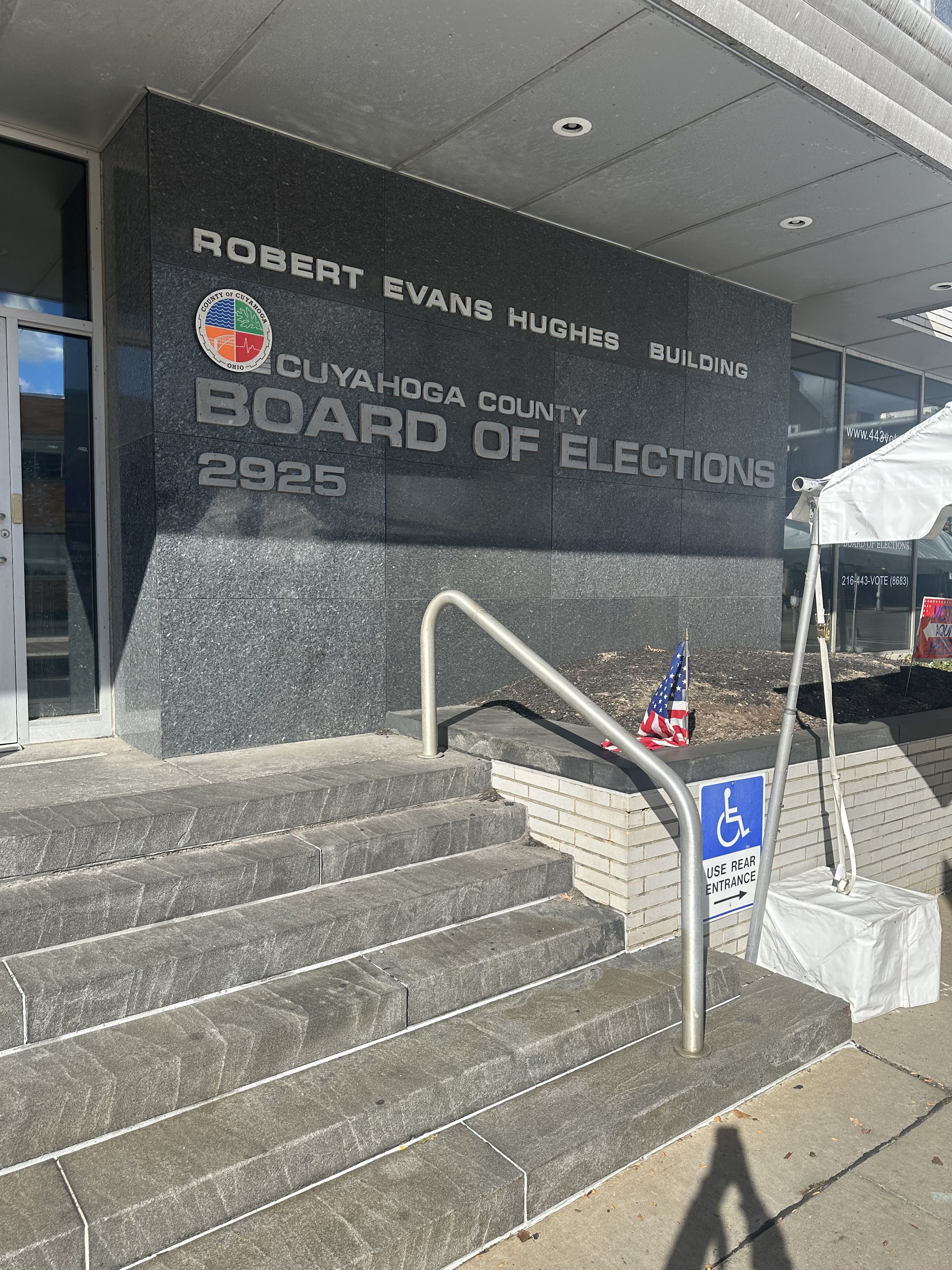
Campaign signs sprawled across lawns, mailed absentee ballots between bills and pizza place coupons, rallies here and rallies there — election season is in full swing.
For many college students, this cycle is a big deal: their first presidential election, not to mention many, many seats up in the air. Below is a rough breakdown of the major races, the candidates, the deadlines and the stakes of this November’s elections —
— because what’s an American election without the high stakes?
United States presidential election
In a rather interesting race, Democratic candidate Vice President Kamala Harris and Republican candidate former President Donald Trump are fighting to be the next U.S. President.
Joining Harris on the ticket for Vice President is Minnesota Governor Tim Waltz, while Trump is joined by U.S. Senator JD Vance of the State of Ohio.
Harris’ journey to the Democratic nomination was unconventional, having occurred following the withdrawal of President Joe Biden from the contest amid concerns from constituents and voters regarding his age and competence. Biden endorsed Harris for the presidency shortly after.
This presidential election cycle is marked by voter concerns over the economy and inflation, U.S. foreign policy, specifically involving Ukraine and Gaza, immigration, abortion, healthcare, and the future composition of the Supreme Court.
Learn more about the candidates and their platforms through their campaign websites.
U.S. Senate elections
Two-time incumbent Senator Sherrod Brown is running to keep his Ohio Senate seat this fall against Republican opponent Bernie Moreno, businessman and founder of CSU’s Center for Sales Excellence.
Brown was first elected in 2006 after defeating former Senator and current Ohio Gov. Mike DeWine. Having won reelection in 2012 and 2018, Democrats consider Brown’s victory this November essential in maintaining the party’s majority in the Senate.
A win for Trump-endorsed Moreno this fall would mark the first time since 2007 that Ohio’s two Senate seats were filled by Republicans. However, this potential moment also depends on the outcome of the presidential race, which features Senator Vance on the Republican ticket as vice president.
If Trump and Vance win the presidency, Vance’s vacant senate seat would prompt a special election under Ohio state law, in which Gov. DeWine appoints a temporary replacement. It wouldn’t be until November 2026, when a special election would be held, that someone would be elected to serve the remaining two years of his six-year term.
Speculation over who DeWine would appoint has produced potential contenders such as Lt. Gov. Jon Husted, Secretary of State Frank LaRose, who lost to Moreno for the Republican nominee for Senate, and Vivek Ramaswamy, entrepreneur and former 2024 Republican presidential candidate.
U.S. House elections
Unlike the Senate, U.S. Representatives face re-election every two years, meaning that all 15 of Ohio’s seats are up in the air this election cycle. 10 Republicans and five Democrats make up the current composition of Ohio’s Senate representation.
U.S. House races tend to be inconsequential at the state level and this cycle shows no major change in that pattern in Ohio. The Hill predicts a 56% chance of Republicans retaining the House. However, it would take only a few flipped seats for the majority party to switch, even if Ohio is not projected to make that difference.
Voters can look up their U.S. representative here.
Ohio General Assembly elections
Many incumbents in the Ohio General Assembly are either retiring or stepping down due to term limits, making this election cycle one with many new names.
16 out of 33 State Senate seats are up for reelection in Ohio, which includes 15 Republicans and one Democrat. All races are contested excluding Republican-led District 12.
All 99 seats of the Ohio State House are up for reelection this cycle, including 67 Republicans and 32 Democrats. 14 of these races are contested, mostly clustered around central Ohio.
Much like the U.S. House, General Assembly races tend to result in little seat-switching, so Republicans will likely maintain their grip on the majority.
Find your state senator here and state house representative here.
Ohio State Supreme Court elections
With six candidates gunning for three seats, Ohioans face an interesting election for the State Supreme Court this cycle. The 4-3 majority Republicans possess in the court could very well be snagged by Democrats.
Incumbent Associate Justice Michael P. Donnelly (D) will compete against Megan Shanahan (R), a judge of the Hamilton County Court of Common Pleas General Division. Her term in said position does not expire until 2029.
Incumbent Associate Justice Melody Stewart (D) will face fellow Associate Justice Joseph Deters (R), who challenged Stewart for her full-term seat instead of finishing out the partial term he was appointed to in 2023 by Gov. Mike DeWine, which expires in December.
Lisa Forbes (D), a judge of the Ohio Eighth District Court of Appeals, will go head-to-head with Dan Hawkins (R), a judge of the Franklin County Court of Common Pleas General Division, for Deters’ vacant seat.
Other judiciary, state executive and municipal races
Over 20 Ohio appellate court judges have expiring terms in 2025 and their seats will be up for contest this November. Six seats on the State Board of Education are also up for reelection and Cuyahoga County will cast its vote for prosecutor, county council members and common plea court judges.
Ballot initiatives
Voters will also cast their vote in ballot measures on the state, county and local levels
“Establish the Citizens Redistricting Commission Initiative,” or Ohio Issue 1, is the lone state ballot initiative this election. Its passage would establish a 15-member commission, excluding politicians, lobbyists, and political donors, tasked with redrawing Ohio’s congressional and senatorial districts. Five Democrat, five Republican and five Independent citizens would make up the committee.
This manner of redistricting differs drastically from the current method, which involves a seven-member panel of bipartisan politicians known as the Ohio Redistricting Commission (ORC). The Ohio State Supreme Court has repeatedly declared that the maps drawn by this panel constituted gerrymandering, specifically favoring Republicans, who have had a grip on the General Assembly for years.
The nonpartisan coalition that proposed the constitutional amendment, Citizens Not Politicians, emphasize that passage of the ballot initiative would ban the drawing of districts that favor or discriminate against a certain political party. Opponents fear it would create a whole unnecessary bureaucracy that would wind up changing nothing about the redistricting process.
Cuyahoga County residents will also be voting on a Cigarette Tax Measure and a Bond and Tax measure for the Cleveland Municipal School District. The former would establish a tax of 3.5 cents per cigarette for 10 years, and the latter would allow the school district to issue up to $295 million in bonds. The revenue would fund building improvements, calling for a property tax levy of $93 per $100,000 in assessed value, and a tax levy of $301 for each $100,000 in appraised value.
Deadlines and important info
Voters can access sample ballots at their respective Board of Elections website. There, they can read the ballot language in full for each race and measure.
Military and overseas absentee ballot voting began Sept. 20. Absentee voting for the rest of voters will begin Tuesday, Oct. 8 and may not be postmarked after Monday, Nov. 4. Early in-person voting will also begin Oct. 8 with varying hours.
Polls are open from 6:30 a.m. to 7:30 p.m. on Election Day, which is Tuesday, Nov. 5. Absentee ballots will also be accepted on Election Day until the same time.
Being in a state with some of the strictest election laws, CSU students should make sure they have proper photo identification when casting their vote.
 Ele Solovyov
  csucauldron